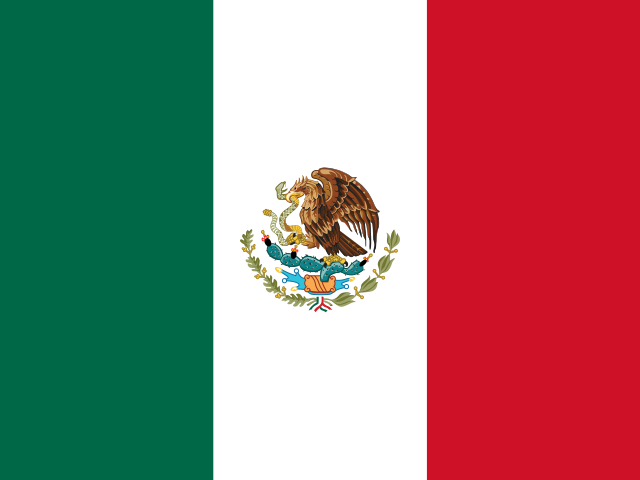
Mexico
Founded in 1927, the Mexico National Soccer Team is one of the most successful teams in North America, with numerous CONCACAF titles and regular FIFA World Cup appearances. Known for its passionate fans, technical skill, and rich football culture, Mexico continues to be a powerful force on the global stage and a proud co-host of the 2026 FIFA World Cup.

Explore the official Mexico National Team squad and get a clear overview of every player selected for the tournament. Discover the key details behind the stars, rising talents, and core squad members who shape the team’s World Cup 2026 campaign.

C. Acevedo
Position
Goalkeeper
Age
29

G. Ochoa
Position
Goalkeeper
Age
40

J. Rangel
Position
Goalkeeper
Age
25

J. Gallardo
Position
Defender
Age
31

C. Montes
Position
Defender
Age
28

I. Reyes
Position
Defender
Age
25

J. Sánchez
Position
Defender
Age
28

J. Vásquez
Position
Defender
Age
27

E. Álvarez
Position
Midfielder
Age
28

M. Chávez
Position
Defender
Age
21

O. Vargas
Position
Midfielder
Age
20

L. Chávez
Position
Midfielder
Age
29

Álvaro Fidalgo
Position
Midfielder
Age
28

B. Gutiérrez
Position
Midfielder
Age
22

É. Lira
Position
Midfielder
Age
25

G. Mora
Position
Midfielder
Age
17

O. Pineda
Position
Midfielder
Age
29

L. Romo
Position
Midfielder
Age
30

R. Alvarado
Position
Midfielder
Age
27

S. Giménez
Position
Attacker
Age
24

A. González
Position
Attacker
Age
22

C. Huerta
Position
Midfielder
Age
25

R. Jiménez
Position
Attacker
Age
34

G. Martínez
Position
Attacker
Age
30

J. Quiñones
Position
Midfielder
Age
28

A. Vega
Position
Attacker
Age
28
Meet the Mexico National Team coaching staff, who play a vital role in preparing the squad for success on the international stage. Working behind the scenes, they support the team’s tactical development, physical conditioning, match preparation, and overall performance throughout World Cup 2026.

Javier Aguirre
Head Coach
Birthday:
Dec 1, 1958
Nationality:
Mexico/Spain

Rafael Márquez
Assistant Coach
Birthday:
Feb 13, 1979
Nationality:
Mexico / Spain

Toni Amor
Assistant Coach
Birthday:
Nov 6, 1976
Nationality:
Spain

Joseba Ituarte
Goalkeeping Coach
Birthday:
Sep 26, 1970
Nationality:
Spain

Pol Lorente
Fitness Coach
Birthday:
Feb 1, 1988
Nationality:
Spain
Explore the latest Mexico matches at the FIFA World Cup 2026 and stay updated on results, key moments, and standout player performances from every game.
Mexico vs England
2 : 3
Jul 6, 2026 • World Cup 2026
Mexico City Stadium, Mexico City
Mexico vs Ecuador
2 : 0
Jul 1, 2026 • World Cup 2026
Mexico City Stadium, Mexico City
Czech Republic vs Mexico
0 : 3
Jun 25, 2026 • World Cup 2026
Mexico City Stadium, Mexico City
Mexico vs South Korea
1 : 0
Jun 19, 2026 • World Cup 2026
Guadalajara Stadium
Mexico vs South Africa
2 : 0
Jun 11, 2026 • World Cup 2026
Mexico City Stadium
Mexico vs Belgium
1 : 1
Apr 1, 2026 • Friendlies
Soldier Field
Mexico vs Portugal
0 : 0
Mar 29, 2026 • Friendlies
Estadio Azteca, Mexico City
Mexico vs Iceland
4 : 0
Feb 26, 2026 • Friendlies
Estadio La Corregidora
Bolivia vs Mexico
0 : 1
Jan 25, 2026 • Friendlies
Estadio Ramon Tahuichi Aguilera Costas, Santa Cruz
Panama vs Mexico
0 : 1
Jan 23, 2026 • Friendlies
Estadio Rommel Fernandez, Panama City
Mexico vs Paraguay
1 : 2
Nov 19, 2025 • Friendlies
Alamodome, San Antonio
Mexico vs Uruguay
0 : 0
Nov 16, 2025 • Friendlies
Estadio Corona, Torreon
Mexico vs Ecuador
1 : 1
Oct 15, 2025 • Friendlies
Estadio Akron, Guadalajara
Mexico vs Colombia
0 : 4
Oct 12, 2025 • Friendlies
AT&T Stadium, Arlington
Mexico vs South Korea
2 : 2
Sep 10, 2025 • Friendlies
Geodis Park, Nashville
Mexico’s path to the 2026 FIFA World Cup was unlike a normal qualifying campaign because there was no qualification road to complete. As one of the three host nations, Mexico received an automatic place in the finals alongside Canada and the United States. FIFA confirmed that all three co-hosts were admitted directly to the tournament, while CONCACAF designed its qualifying competition around the remaining regional spots. That means Mexico did not play group-stage qualifiers, did not enter a playoff, and did not collect qualification points in this cycle. Instead, El Tri used the period to prepare through friendlies, regional competition, and squad development ahead of hosting matches on home soil. The automatic spot guarantees Mexico another World Cup appearance without the pressure of navigating the usual CONCACAF route, but it also brings major expectations. With the World Cup beginning in Mexico City on June 11, 2026, Mexico enters the tournament as a proud co-host, with the opportunity to draw on home support and chase a memorable run on football’s biggest stage.
Mexico made its FIFA World Cup debut in 1930 and has since built one of the richest World Cup histories in CONCACAF. The national team became a regular presence on football’s biggest stage and is known for its consistency, passionate support, and strong tradition of reaching the knockout rounds.
As one of the tournament’s most frequent participants, El Tri has produced a long list of memorable performances, with the quarter-final runs in 1970 and 1986 standing above the rest. Both came on home soil and turned Mexico into the center of the football world, especially at the legendary Estadio Azteca. One of the most iconic moments arrived in 1986, when Manuel Negrete scored his spectacular volley against Bulgaria, still remembered as one of the greatest World Cup goals ever.
At the same time, the World Cup has brought painful moments, especially repeated exits in the Round of 16, a pattern that became one of the defining frustrations in the team’s modern history. Still, Mexico’s World Cup story remains one of passion, resilience, and lasting football tradition.
Mexico have appeared at the FIFA World Cup 18 times, with 2026 set to be their 19th participation as co-hosts. El Tri are one of the most frequent World Cup nations and have been a constant presence in the modern era.
Mexico’s best World Cup finish is the quarter-finals, reached in 1970 and 1986, both on home soil. Those runs remain the high points of the nation’s World Cup history.
Luis Hernández is Mexico’s top World Cup scorer with four goals. He starred at the 1998 World Cup, where all four of those goals were scored.
Rafael Márquez holds Mexico’s record for most World Cup matches played, with 19 appearances across five tournaments. His longevity made him one of the defining leaders in El Tri’s modern World Cup story.
In 1986, Manuel Negrete scored his spectacular volley against Bulgaria, one of the most iconic goals in World Cup history. Mexico also made history by hosting the men’s World Cup twice before 2026, more than any other nation at the time.

Luis Chávez
A technically gifted midfielder known for his passing range and long-range shooting. Chávez adds creativity and control in central areas and has delivered decisive goals on the international stage.

Johan Vásquez
A centre-back from the new generation, Vásquez combines defensive intelligence with confident play in possession. He has become a reliable option in Mexico’s evolving back line heading toward 2026.

Guillermo Ochoa
Famous for his spectacular World Cup performances, Ochoa has delivered iconic saves on the global stage. As Mexico’s long-standing No.1 goalkeeper, he played a key role in qualification campaigns and remains a symbol of consistency and reliability.

Edson Álvarez
The defensive backbone of El Tri, Álvarez anchors midfield with strength, positioning, and leadership. His ball-winning ability and tactical discipline make him vital in high-pressure matches.

Hirving Lozano
One of Mexico’s brightest modern stars, Lozano combines speed, creativity, and clinical finishing. His goal vs Germany in the 2018 World Cup became legendary. He was also crucial in recent qualifying cycles with his attacking impact on the wings.

Santiago Giménez
A major figure in the new generation, Giménez has emerged as Mexico’s top scoring talent heading into 2026. As a centre-forward, his breakout performances in Europe highlight his growing importance for Mexico’s future World Cup ambitions.
Hugo Sánchez
Widely regarded as Mexico’s greatest footballer, Hugo Sánchez starred as a prolific striker for Real Madrid and the national team. Known for his acrobatic finishes and clinical scoring, he helped elevate Mexico’s global reputation.
Rafael Márquez
Nicknamed El Káiser, Márquez is one of the only players to appear in five World Cups. Renowned for his leadership and versatility in defense and midfield, he played for elite clubs like Barcelona and is considered one of Mexico’s greatest captains.
Andrés Guardado
A long-time backbone of El Tri, Guardado brought experience and leadership over five World Cup cycles. His ability to control tempo and contribute in both attack and defense made him one of Mexico’s most capped players ever.
Cuauhtémoc Blanco
One of the most iconic and charismatic players in Mexican football history, Blanco was known for his creativity, flair, and decisive goals. He scored in three different World Cups and remains a symbol of El Tri’s fighting spirit.
Follow Mexico at the FIFA World Cup 2026 and discover where the team will play throughout the tournament. Explore the full match schedule, host cities, and stadiums set to stage some of the competition’s biggest moments. From group-stage fixtures to possible knockout-round drama, find everything you need to experience the action live at football’s biggest event.
Mexico has played at the FIFA World Cup 17 times before 2026.
Mexico has never reached a FIFA World Cup final.
Mexico has reached the knockout rounds 9 times before 2026 (1970, 1986, 1994, 1998, 2002, 2006, 2010, 2014, 2018).
Mexico’s best finish is the quarter-finals, achieved in 1970 and 1986.
Mexico’s worst World Cup outcomes have been repeated group-stage exits.
Mexico’s most famous rivalry is with the United States, widely seen as the defining rivalry in CONCACAF.
Mexico qualified automatically as a co-host nation, alongside the USA and Canada.
Mexico’s group-stage matches are scheduled in Mexico City and Guadalajara. They open against South Africa in Mexico City on June 11, 2026, then play Korea Republic in Guadalajara on June 18, 2026, and finish the group against Czechia in Mexico City on June 24, 2026.

The no 1 marketplace in the world
Ticombo® is now the most followed of all reselling platforms in Europe. Thank you!
Seal of Excellence by EU Commission
Ticombo GmbH (parent company) is recognized under Horizon 2020, the EU's research and innovation funding program for its proposal No. 782393.

As seen on the news